
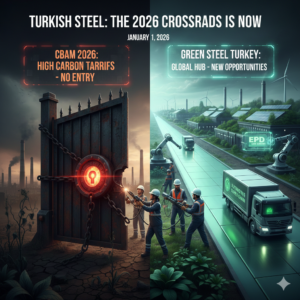
For years, “Sustainability” has been treated as a corporate buzzword or a distant target for the 2030s. But as we look toward January 1, 2026, the rhetoric is over. The European Union’s Carbon Border Adjustment Mechanism (CBAM) is no longer a policy proposal—it is a full-scale structural shift that is about to hit the balance sheets of every Turkish steel reroller and automotive supplier.
If you are manufacturing in Turkey, 2026 isn’t just another year on the calendar. It is a deadline that will separate the market leaders from the casualties of the “Carbon Wall.”
The Hidden Cost in Your Supply Chain
The real danger for Turkish rerollers isn’t necessarily their own factory floor; it’s their procurement strategy. If you are importing slabs or billets produced through high-emission routes, you are essentially importing a massive tax bill that will be due the moment your finished goods cross the EU border. The competitive advantage Turkey has built on logistics and flexible production is being systematically neutralized by carbon intensity.
In the automotive sector, the pressure is even more direct. Companies like VW, BMW, or Stellantis are moving beyond standard ISO certifications. They are now auditing “Carbon Transparency.” If you cannot back up a stamped part or a cold-rolled coil with verifiable, data-driven emission reports, you are effectively invisible to their future procurement cycles.
The Strategy: Beyond Compliance
Survival in this new era isn’t about ticking boxes for a consultant. It requires a fundamental pivot in how we handle operations:
- Rethinking Raw Materials: We need an immediate shift toward sourcing low-emission inputs. The relationship between the reroller and the primary producer must evolve into a strategic partnership focused on carbon footprints, not just price-per-ton.
- Energy as a Strategic Asset: Every kilowatt-hour used in a Turkish plant is now a line item in a border tax calculation. Investing in onsite renewables (SPP/WPP) is no longer an “ESG project”—it is a direct de-risking of your export margins.
- The Data Revolution: You cannot manage what you do not measure. Moving away from manual reporting to automated systems that track energy consumption in real-time is no longer optional. This is the only way to provide the “Digital Product Passport” that will soon be a mandatory ticket to enter the European market.
The Verdict
Turkey has a unique window of opportunity. Our proximity to Europe and our highly adaptable industrial base mean we can win this race. But the window is closing fast. By the time 2026 arrives, the winners will already have their green supply chains and digital tracking systems in place.
The question every Turkish industrialist needs to ask today is simple: Is your product ready to be taxed at the border, or are you ready to lead the green transition?